
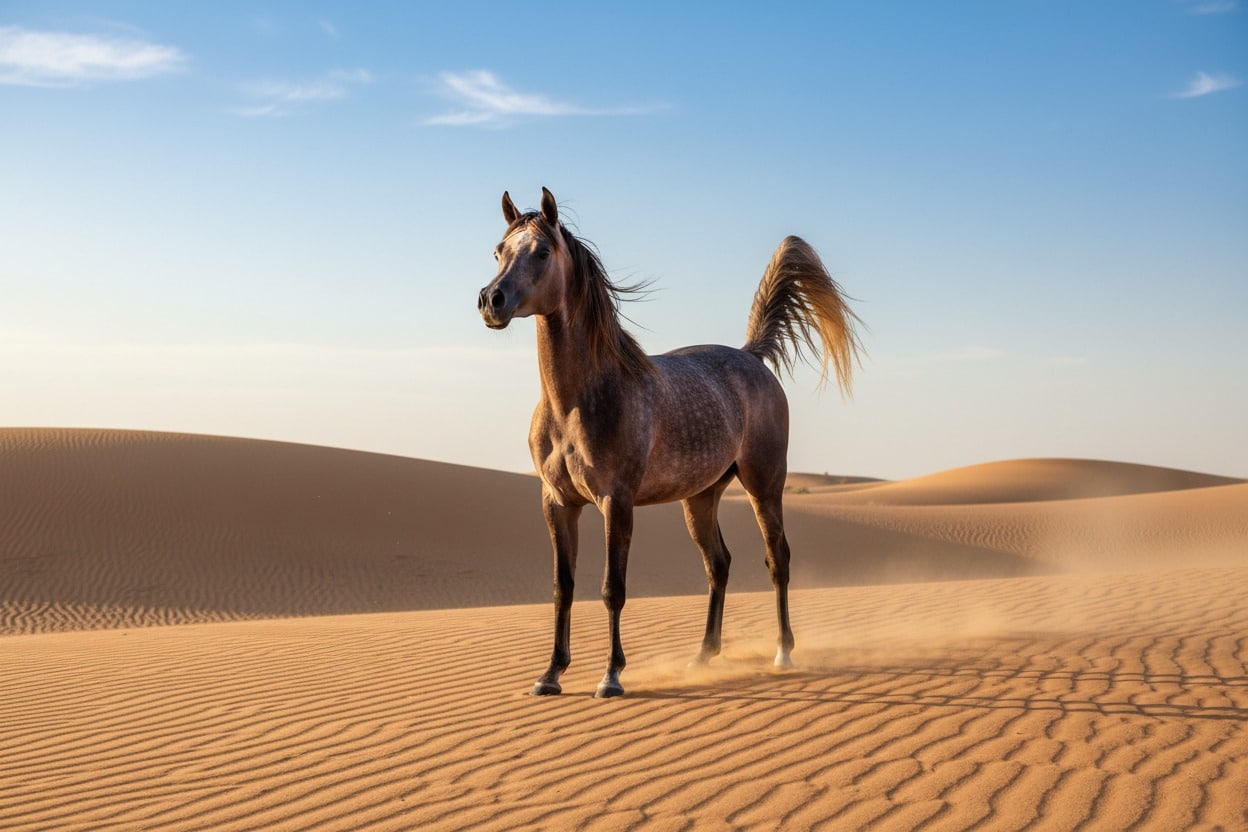
Show someone a photo of a horse with a dished face, an arched neck, and a tail carried like a flag, and most people will say the same word: Arabian. Few breeds are as instantly recognizable, and few have shaped the horse world as deeply.
The Arabian horse is admired for its beauty, but its reputation rests on stamina, intelligence, and a long partnership with people. This guide covers the breed’s history, appearance, temperament, health, uses, and costs, with an honest look at who an Arabian suits and who might struggle.
This article is for general education and is not veterinary advice. For questions about a specific horse, talk to your veterinarian.
In This Article
- History and Origin of the Arabian Horse
- Physical Characteristics
- Arabian Horse Temperament and Personality
- Arabian Horse Lifespan and Health
- Uses and Disciplines
- How Much Does an Arabian Horse Cost?
- Arabian Horse vs. Thoroughbred
- Is an Arabian Horse Right for You?
- FAQ
History and Origin of the Arabian Horse
Arabian horse history begins on the Arabian Peninsula. The Arabian Horse Association (AHA), the breed registry for North America, describes the Arabian as the oldest pure breed of horse in the world [1]. That is the association’s own claim, and the breed’s earliest history is poorly documented.
Bedouin Breeders and Desert Culture
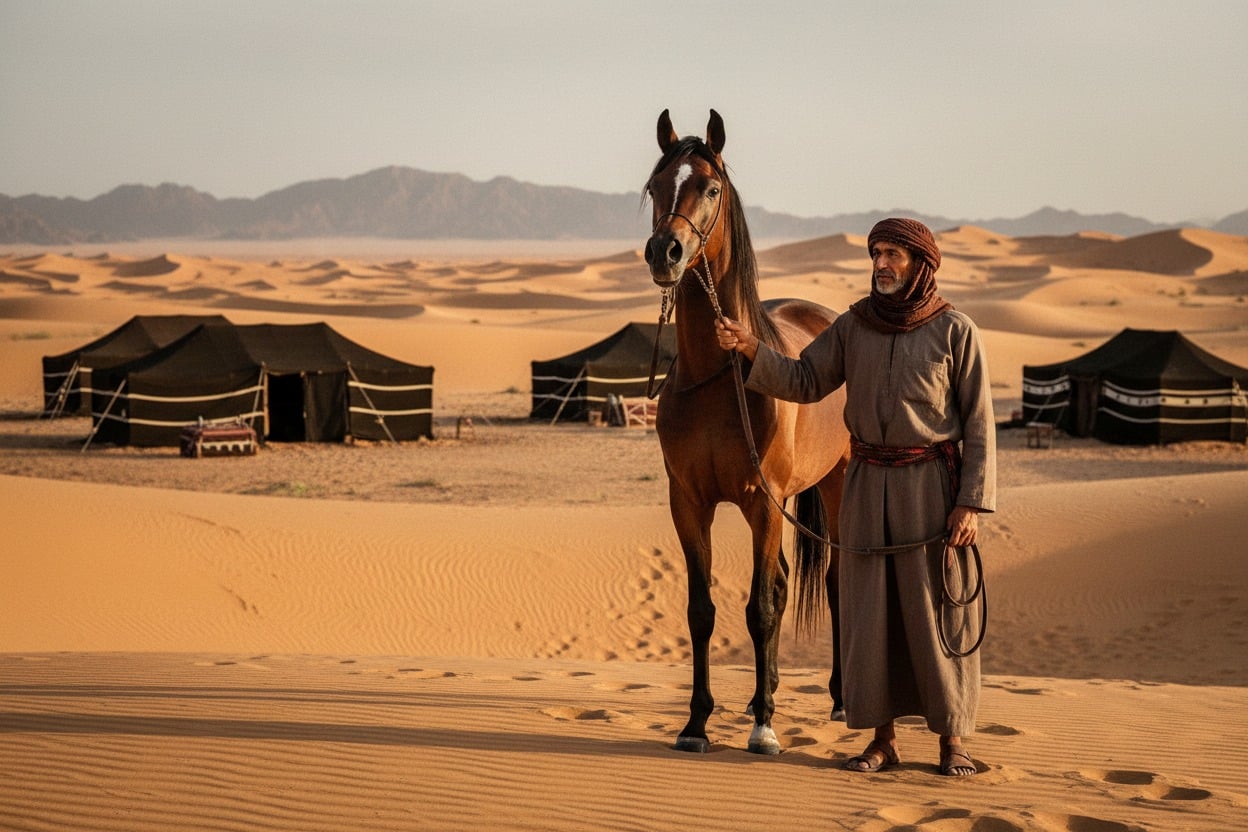
Bedouin tribes of the desert prized their horses, and the stories they told about the breed’s origins are rooted in legend, including the belief that the horse was a gift from God [3]. Those who bred them are generally credited with selecting for courage, endurance, and a gentle manner around people [14].
A word of caution on dates. You will often see claims that the breed dates back 4,500 years or more. These figures are estimates drawn from art and tradition, not from documented pedigrees, so treat them as approximations rather than established fact.
The Arabian’s Influence on Other Breeds
The Arabian’s influence on other horses is hard to overstate. The Thoroughbred traces to three foundation stallions imported to England between the late 1600s and early 1700s, known as the Byerley Turk, the Darley Arabian, and the Godolphin Arabian (also called the Godolphin Barb) [4]. The exact breeding of those stallions is debated by historians, but Arabian blood is part of the story. Thoroughbred blood, in turn, helped build breeds such as the American Quarter Horse and the Standardbred [12].
AHA materials describe the Arabian as a foundation breed whose blood appears in nearly every light horse breed today [1]. The association also registers Half-Arabians (one purebred Arabian parent) and Anglo-Arabians (Arabian and Thoroughbred crosses) [2].
Physical Characteristics
Head and Facial Profile
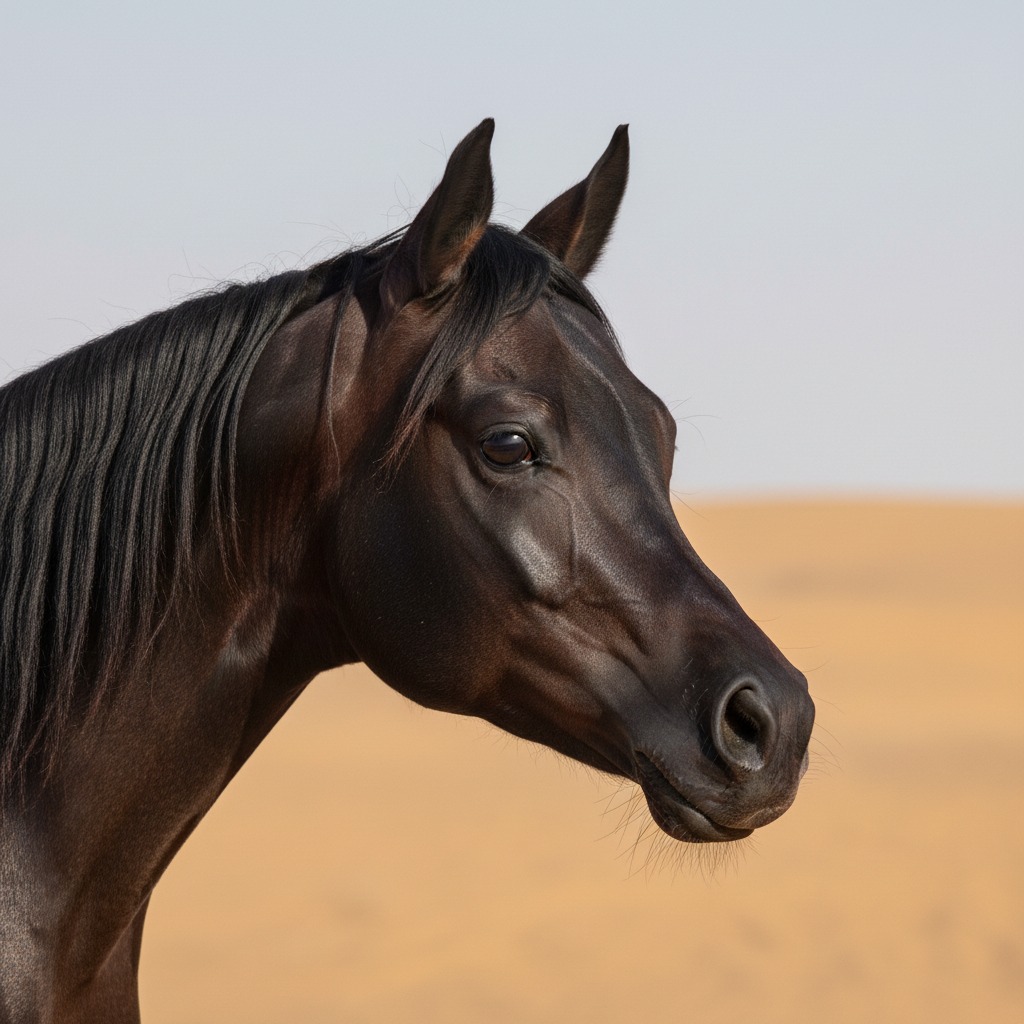
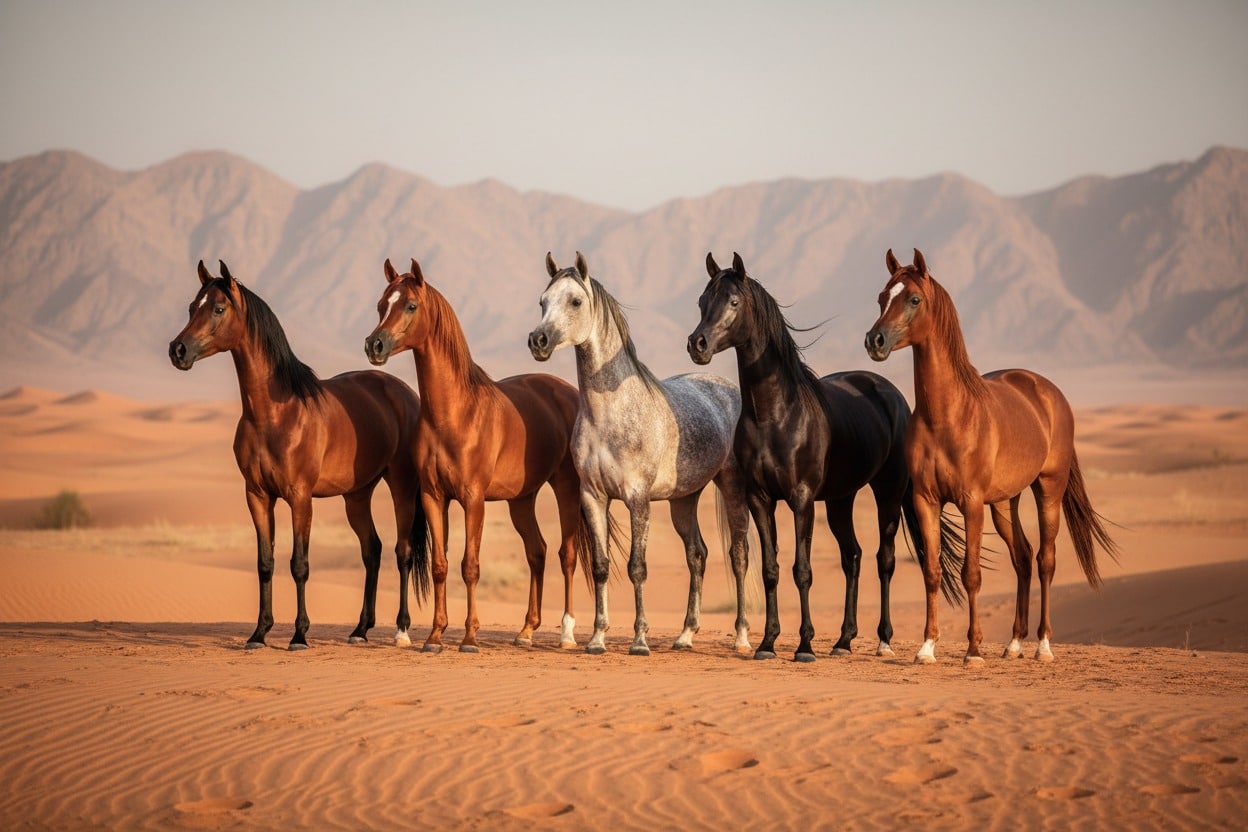
The face is the breed’s signature. A typical Arabian has a small head that is slightly concave below the eyes, large, wide-set eyes, large nostrils, and a small muzzle [5]. Breeders call this profile “dished.”
Body Structure and Proportions
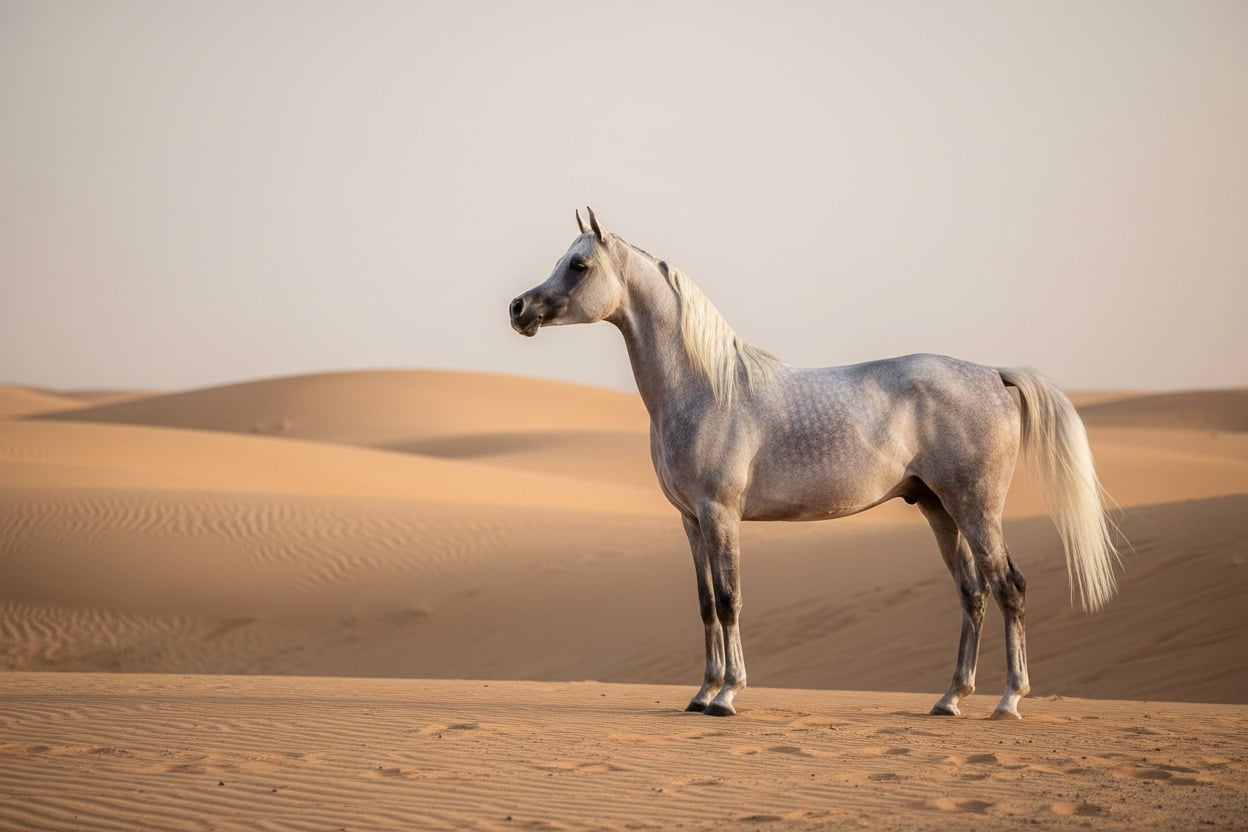
Arabians are compact and athletic. Breed descriptions highlight a long, arched neck, a deep chest, a short back, a level croup, and a naturally high tail carriage [5]. They are often described as having dense bone for their size, which helps them carry riders despite a lighter frame.
Arabian Horse Height and Weight
Arabians are small to medium horses. Oklahoma State University’s breed library lists most Arabians at 14.2 to 15.2 hands and 800 to 1,000 pounds [3], and AHA materials give a similar range [1]. Other references cite 14.1 to 15.1 hands. A hand equals four inches, and horses are measured from the ground to the top of the withers (the high point at the base of the neck).
Individuals vary, and crosses with other breeds are often taller.
Arabian Horse Colors
Common colors include bay, chestnut, gray, black, and roan [19]. Gray is especially associated with the breed, and many gray Arabians are born darker and lighten with age.
Arabian Horse Temperament and Personality
Arabians are classed as “hot-blooded” horses, a traditional term for breeds developed for speed and stamina that are generally more energetic and reactive than “cold-blooded” draft types. That label is a general tendency, not a personality guarantee.
Intelligence and sensitivity. Arabians are widely described as quick learners who notice everything. That intelligence cuts both ways: a horse that learns fast can also learn bad habits fast, and a sensitive horse may react strongly to rough handling or confusing cues.
Relationship with humans. Their long history of close contact with people is often credited for an affectionate, people-oriented nature. The AHA notes that many Arabians have naturally good dispositions, but that like any horse, they can still become nervous or anxious [13].
Energy and behavior. Expect a horse with a lot of “go.” Many Arabians do well with regular exercise, mental variety, and fair, consistent handling. Boredom can show up as fidgeting or mischief.
Suitability for different riders. Because individual horses vary so much, the best match depends on the horse’s training and the rider’s skill. We cover beginner suitability in more detail below.
Arabian Horse Lifespan and Health
How Long Do Arabian Horses Live?
Arabian horse lifespan is commonly cited at 25 to 30 years, and some sources list up to 35 or more with good care. That range is in line with horses in general, and exact numbers are hard to verify because horse ages and records vary [16]. The oldest finisher of the 100-mile Tevis Cup endurance ride was reportedly a 27-year-old Arabian gelding [15]. Treat that as a notable example, not an average.
Nutrition, dental and hoof care, workload, and veterinary attention all influence how long any horse stays healthy and sound.
Inherited Conditions in Arabians
Arabians are among the breeds with well-characterized inherited conditions, and genetic tests now exist for several. Veterinary journals list the following as known mutations in the breed [7]:
- Severe combined immunodeficiency (SCID): an immune disorder that leaves foals unable to fight infection. It is recessive, meaning a foal needs two copies of the gene.
- Cerebellar abiotrophy (CA): an inherited neurological condition in which a foal’s cerebellum (the brain region that coordinates movement) loses neurons. UC Davis describes head tremors and ataxia, or lack of coordination, as signs [6]. It is a recessive trait [17].
- Lavender foal syndrome (LFS): a fatal condition that UC Davis describes as found primarily in Arabians, with a diluted coat color and severe neurological problems [6].
- Occipitoatlantoaxial malformation (OAAM): a malformation at the top of the neck that has also been identified in the breed [12].
A carrier has one copy of a recessive gene and usually looks normal. Problems arise when two carriers are bred. Research from South Africa suggests that genetic screening for SCID may have helped reduce carrier prevalence in the breeding population [8].
Arabian foals can also develop juvenile idiopathic epilepsy, which research has found is not linked to the four mutations above [18].
Preventive Care
- Ask for genetic test results. If you are buying a foal or breeding, ask for results for the conditions above, and confirm them with a veterinarian.
- Get a pre-purchase exam for any horse you consider buying.
- Stay current on routine care. That includes vaccinations, deworming, dental work, and hoof care as recommended by your veterinarian.
- Plan conditioning carefully for horses in athletic work, and increase workload gradually.
Arabian Horse Uses and Disciplines
Endurance Riding
Endurance riding is the Arabian’s best-known arena. Competitions typically cover 25 to 100 miles, and the American Endurance Ride Conference (AERC) governs most US rides [9]. The Tevis Cup, a 100-mile ride through the Sierra Nevada, is considered the sport’s founding ride [9]. Arabians and Arabian crosses are known to dominate: one magazine report puts the share of winning Tevis horses at 95 percent Arabian or part Arabian [11], and the AHA says the top 20 finishers in 2021 rode Arabians [10].
You can compete in endurance on many breeds, but the Arabian’s efficient build and recovery have made it the benchmark.
Show Competitions
Arabian shows are a major part of the breed’s culture, with classes that judge type, movement, and training. The AHA also promotes the breed through Sport Horse in Hand classes, which evaluate movement, conformation, and overall impression [5].
Trail Riding
Arabians are popular trail horses, valued for stamina and surefootedness. They often have enough energy to cover long distances, but a spooky or high-strung individual may not suit a casual rider.
English and Western Riding
The breed competes in both English and Western disciplines, as well as driving. Breed references list riding, driving, showing, and pleasure riding among its common uses [19].
How Much Does an Arabian Horse Cost?
There is no single price for an Arabian, and we won’t offer one. Prices vary widely by region, season, and individual horse. Here are the main factors.
- Training and experience. A well-trained, reliable riding horse usually costs more than an unstarted youngster.
- Bloodlines and pedigree. Show or breeding prospects from well-known lines can command higher prices, while a pleasure or trail horse typically costs less.
- Age. Prices change as horses move through training, competitive, and senior stages.
- Health and soundness. A clean pre-purchase exam and genetic testing results add value.
- Intended use. A proven endurance or show horse is priced differently from a companion.
Ownership costs. The purchase price is only the beginning. Budget for board or property costs, hay and feed, farrier care, routine veterinary care, tack, lessons or training, and an emergency fund. Get local quotes from boarding barns, farriers, and veterinarians.
To research available horses, start with the AHA and reputable breeders, and ask for references.
Arabian Horse vs. Thoroughbred
The two breeds are related by history, but they were developed for different jobs: the Arabian for desert endurance, the Thoroughbred for racing over distance on the flat.
| Feature | Arabian | Thoroughbred |
|---|---|---|
| Origin | Arabian Peninsula | England |
| Typical height | About 14.1–15.2 hands | Most 15.2–17 hands [12] |
| Build | Compact, short back, dense bone, high tail carriage | Taller, lean, long-legged, built for speed |
| Head | Dished profile, large eyes, small muzzle | Fine, refined head with a straight profile |
| Temperament tendencies | Intelligent, sensitive, people-oriented | Spirited, bold, often energetic |
| Strength | Endurance and recovery | Speed over racing distances |
| Common uses | Endurance, showing, pleasure, trail | Racing, eventing, hunter/jumper, retraining as sport horses |
| Registry | Arabian Horse Association | The Jockey Club |
Speed is a common question. Thoroughbreds are bred for racing and are generally faster over typical racing distances, while Arabians are known for staying power over long distances. Both are “hot-blooded” types, so a quiet individual of either breed can be a great partner, and a high-strung one of either can be a lot to handle.
Is an Arabian Horse Right for You?
Advantages
- Strong stamina and athleticism for endurance and trail work.
- Intelligent and eager to engage with people.
- Versatile across English, Western, driving, and endurance.
- A moderate size that many riders find manageable.
Challenges
- Sensitivity can be demanding for riders who give unclear signals.
- Some individuals are energetic or reactive.
- Inherited conditions make breeding and foal-buying decisions more complex.
- Intelligent horses need mental work and consistency.
Beginner Suitability
Some Arabians are excellent for newer riders, especially older, well-trained horses with a calm record. Others are better for experienced handlers. The horse’s training, health, and temperament matter more than the breed. If you are new to horses, work with an instructor, try the horse several times, and get a pre-purchase exam.
Ownership Considerations
Think about your goals first: endurance, showing, trail riding, or companionship. Then match the horse to your experience, budget, and time. Connect with local breed clubs and riding groups to meet owners and learn what living with an Arabian is really like.
Frequently Asked Questions
How long do Arabian horses live?
Commonly 25 to 30 years, with some sources listing 35 or more with excellent care. Individual lifespan depends on genetics, nutrition, dental and hoof care, workload, and veterinary attention.
Are Arabian horses good for beginners?
Some are, but it depends on the individual. A well-trained, calm, older Arabian can suit a newer rider. A young, sensitive, or green horse is a poor match for a beginner. Work with an instructor.
Are Arabian horses fast?
They are athletic and capable of speed, but Thoroughbreds are generally faster over typical racing distances. The Arabian’s strength is stamina over long distances.
What makes Arabian horses special?
The dished face, arched neck, and high tail carriage make them easy to recognize, and their stamina, intelligence, and long partnership with people set them apart. Their blood also helped shape many other breeds, including the Thoroughbred.
How much does an Arabian horse cost?
It varies widely with training, bloodlines, age, health, and location, so there is no reliable single figure. Budget for ongoing care, and get local quotes and a pre-purchase exam.
Are Arabian horses good endurance horses?
Yes. They are the dominant breed in competitive endurance riding, including the Tevis Cup, though horses of other breeds also complete rides successfully.
Conclusion
The Arabian horse earns its fame. It is a very old breed, a foundation for many others, and one of the most capable endurance horses in the world, with a distinctive look that no other breed quite matches.
It is also a sensitive, energetic, intelligent horse that rewards good handling and requires informed choices about health and breeding. If you do your homework, work with a trusted instructor or breeder, and match the horse to your experience, an Arabian can be an extraordinary partner.
Sources and References
- Arabian Horse Association, AHA guidebook
- Arabian Horse Association, Arabian breed standard flyer
- Oklahoma State University, Breeds of Livestock, Arabian Horses
- Encyclopaedia Britannica, Thoroughbred
- Horse Illustrated, The Arabian Horse
- UC Davis Veterinary Genetics Laboratory, Arabian breed genetic tests
- Aleman M. et al., “Investigation of Known Genetic Mutations of Arabian Horses in Egyptian Arabian Foals with Juvenile Idiopathic Epilepsy,” Journal of Veterinary Internal Medicine (2018): eScholarship
- “The carrier prevalence of severe combined immunodeficiency, lavender foal syndrome and cerebellar abiotrophy in Arabian horses in South Africa,” Equine Veterinary Journal (2014): PubMed
- American Endurance Ride Conference, AERC Overview
- Arabian Horse Association, Distance Riding
- Cowgirl Magazine, Distance Endurance Riding (secondary source)
- Mad Barn, Thoroughbred breed profile (secondary source)
- Mad Barn, Arabian breed profile (secondary source)
- Horse Racing Sense, Arabian horse breed profile (secondary source)
- Wikipedia, Tevis Cup (secondary source)
- Chewy Education, How Long Do Horses Live? (secondary source)
- Kentucky Equine Research, Arabian horse mutation linked to cerebellar abiotrophy
- EQUUS, Genetic disorder in Arabians investigated
- Horses Only, Arabian horse breed guide (secondary source)
Editor’s note: sources marked “secondary” support general claims such as lifespan ranges, colors, and the Tevis winner share. Verify them against primary sources (AHA, AERC, veterinary references) before publishing.
Leave a Reply